Ohio Cannabis Laws 2026: A Practical Guide for Adult-Use Consumers
Ohio's adult-use cannabis framework has now been through two full years of real-world operation. The headlines are behind us; the actual law is what Monroe consumers need to know in 2026. Here is the practical picture.
The Framework: Medical (2016) + Adult-Use (Issue 2, 2023)
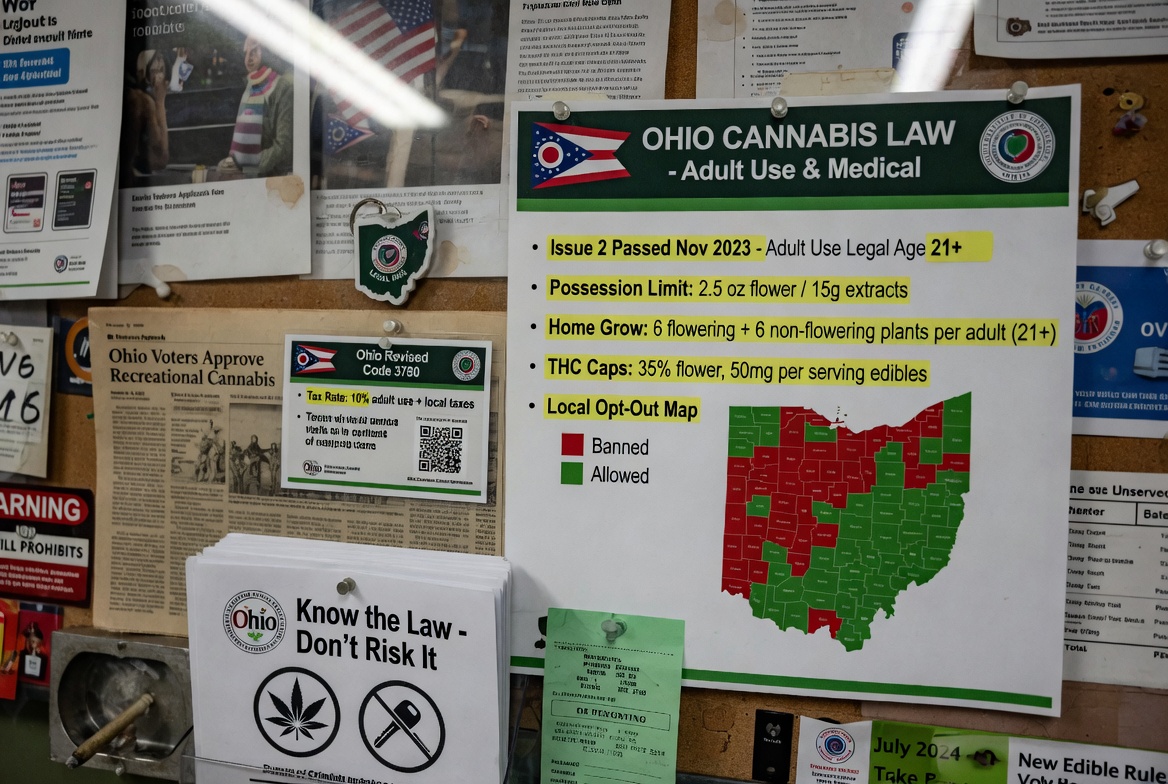
Ohio's current cannabis legal landscape rests on two layers. The first is the Ohio Medical Marijuana Control Program authorized in 2016 via HB 523, which established a qualifying-conditions-based medical program with licensed cultivators, processors, testing labs, and dispensaries. The second is Issue 2, the November 2023 voter-approved citizen initiative that legalized adult-use cannabis for Ohioans 21 and older. Issue 2 amended the Ohio Revised Code rather than the Ohio Constitution, meaning the legislature retains the ability to modify its terms — a recurring tension point in Ohio cannabis policy.
Who Regulates Cannabis in Ohio
As of 2024, Ohio consolidated cannabis oversight under the Division of Cannabis Control within the Department of Commerce. DCC licenses cultivators, processors, testing labs, and dispensaries; sets product testing and labeling standards; and enforces the adult-use framework. The Ohio Pharmacy Board continues certain functions related to medical patient registration.
Possession Limits for Adults 21+
Ohio adults 21+ may possess up to 2.5 ounces of cannabis flower and up to 15 grams of cannabis extract outside their home. At home, consumers may possess larger amounts — the adult-use framework is oriented around consumption in private residences and is strict about public consumption. Transport in vehicles must be in sealed original packaging in a locked compartment or in a part of the vehicle the driver cannot reach while driving; the common-sense read is trunk-only, sealed packaging.
Home Cultivation
Issue 2 permits home cultivation of up to 6 cannabis plants per adult, with a household cap of 12 plants total regardless of how many adults reside there. Plants must be grown in an enclosed, locked area inaccessible to minors, and any harvested cannabis stored securely. Home-cultivated cannabis cannot be sold. Buying seeds, clones, and cultivation supplies is entirely legal and commercially available in Ohio.
Where Cannabis Can Be Consumed
Legal consumption is in private residences and on private property with the owner's permission. Public consumption remains illegal. Cannabis consumption is prohibited in vehicles, in public spaces, in state parks, in places where smoking tobacco is prohibited, and (obviously) anywhere federally-controlled. The short version: your home, your friends' homes, and private events on permitting property.
The Adult-Use Tax Structure
Ohio adult-use cannabis carries a 10% state adult-use excise tax on top of applicable state and local sales tax (typically 7.75% in Butler County, varying slightly by municipality). Medical cannabis purchases under the medical program carry different tax treatment — medical patients generally pay state sales tax but are exempt from the adult-use 10% excise, which is a meaningful savings for regular-purchasing patients.
Impaired Driving
Ohio treats impaired driving seriously regardless of whether the impairing substance is alcohol, cannabis, or prescription medication. Ohio's per-se THC limits are set at the state level, and Ohio's OVI (Operating a Vehicle Impaired) laws are enforced by state, county, and municipal police. The I-75 corridor through Monroe is actively patrolled. The practical rule: don't drive after consuming — any amount, not just "a lot."
Workplace Rules
Adult-use legalization does not override employer drug testing policies. Ohio employers may continue to test for cannabis and condition employment on negative test results — a policy choice, not a legal prohibition. Federal-contract employers, DOT-regulated positions, and safety-sensitive roles face specific federal requirements. Check your employer's policy before consuming.
What the Legislature Has Tweaked
Because Issue 2 was a statutory initiative rather than a constitutional amendment, the Ohio General Assembly has authority to revise specific provisions. In the period since Issue 2's passage, legislative discussion has focused on tax allocation, licensing cadence, local-authority questions, and public-consumption rules. Consumers should expect some details to continue evolving; the core framework (21+ adult use, licensed retail, 2.5 oz, 6 plants) is stable.
Common Misunderstandings
A few recurring confusions: (1) "Medical patients don't need to show ID" — they do; medical card plus government ID. (2) "I can smoke in my rental car if I'm parked" — no; any vehicle consumption creates compliance risk. (3) "Delivery is available everywhere" — Ohio's delivery framework is narrower than some other states, and most Ohio consumers buy via pickup rather than delivery. (4) "Hemp-derived Delta-8 is legal and interchangeable with dispensary cannabis" — the legal treatment of hemp-derived intoxicants is separate and contested; if you want lab-tested, DCC-regulated product, buy at a dispensary.
Summary
Ohio's cannabis legal framework for 2026 is: 21+ adult-use plus existing medical program, 2.5 oz flower / 15g extract possession, 6 plants per adult / 12 per household home grow, private-property consumption only, DCC licensing of all retail, and 10% adult-use excise plus sales tax. Issue 2 delivered the framework; two years of operation have stabilized the details. For Monroe consumers, that means a reliable, regulated market with predictable rules — and a substantial step up from the pre-2024 medical-only era.