How Ohio Got Here: From Medical 2016 to Adult-Use 2024 and What Changed
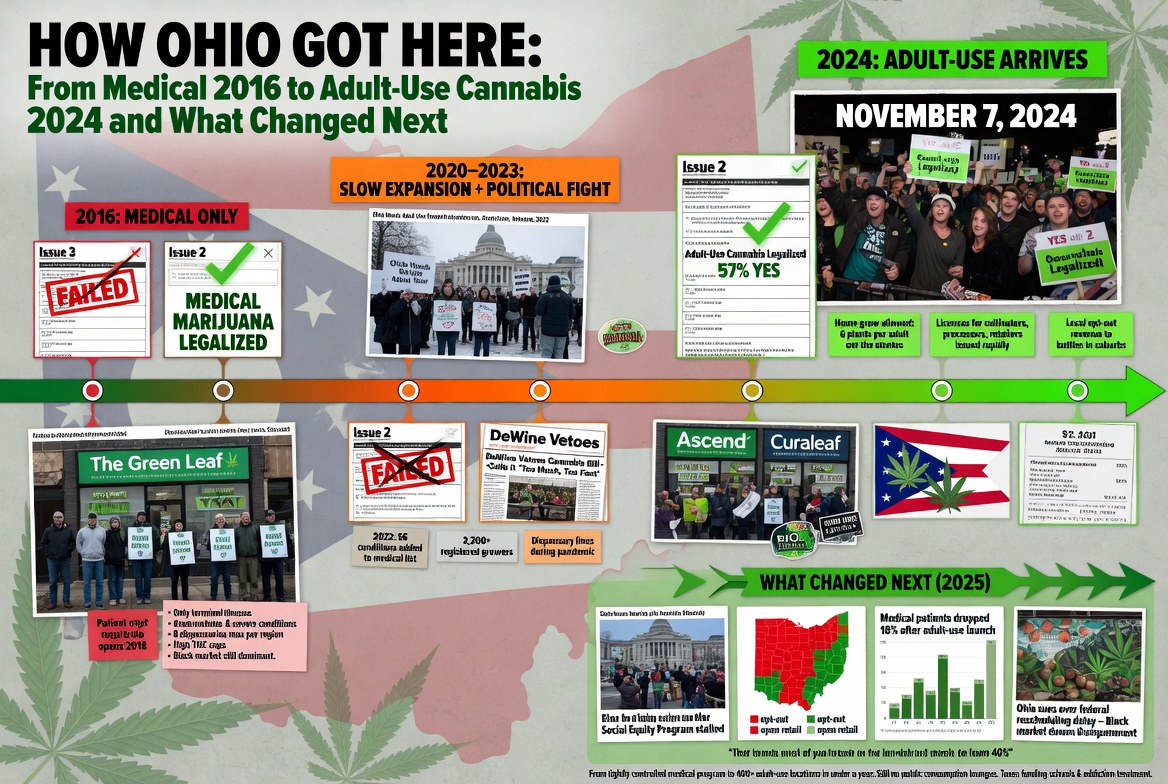
Ohio's cannabis story has two turning points and a long connecting era. It started with federal prohibition, arrived at medical legalization in 2016, and became an adult-use state via Issue 2 in 2023. Understanding the arc helps explain what 2026 Ohio cannabis looks like now.
The Prohibition Era
Like every U.S. state, Ohio criminalized cannabis under the federal Controlled Substances Act framework and its predecessors. Cannabis remained a fully prohibited substance in Ohio throughout most of the 20th century, with possession and sale penalties scaling up as federal drug policy tightened. Ohio decriminalized small-amount possession in 1975 (a notable early step), but full prohibition of dispensing and broader commercial sale remained state law into the 2010s.
Medical Legalization — HB 523 (2016)
In 2016, the Ohio General Assembly passed House Bill 523, creating the Ohio Medical Marijuana Control Program. The law authorized a qualifying-conditions-based medical program: patients with diagnosed qualifying conditions could receive a recommendation from a certified physician, register with the state, and purchase cannabis from a licensed Ohio medical dispensary. Cultivators, processors, testing labs, and dispensaries required distinct state licenses. The first Ohio medical dispensaries opened in early 2019.
The Medical Program's First Years
Ohio's medical program expanded steadily from 2019 through 2023. By 2023, the state had approximately 60 medical dispensaries, several dozen licensed cultivators and processors, and a patient registry with hundreds of thousands of registered patients. The program was conservative by design — qualifying conditions were defined narrowly, pricing ran higher than other medical states, and product variety initially lagged. Over time, conditions were added, the product catalog broadened, and pricing moderated. The program developed the regulatory infrastructure — product testing, labeling standards, dispensary operations — that would later underpin adult-use.
The Ballot Path — Issue 2 (November 2023)
After a failed earlier legalization effort (Issue 3 in 2015, which had a controversial structure rejected by voters), Ohio returned to the question in 2023 with Issue 2 — a citizen-initiated statute legalizing adult-use cannabis for Ohioans 21 and older. Issue 2 passed with a 57% yes vote in November 2023, making Ohio the 24th state to legalize adult-use cannabis. Because Issue 2 was a statutory initiative (amending the Revised Code) rather than a constitutional amendment, the legislature retains authority to revise it — a structural choice that has shaped post-passage policy debates.
The Adult-Use Rollout (2024)
Adult-use sales in Ohio launched in August 2024, with existing medical dispensaries permitted to serve adult-use customers under a dual-license structure. The rollout was faster than many observers expected — states like New York and New Jersey had taken much longer from legalization to retail. Ohio's head start was simple: the medical program infrastructure was already in place, and the adult-use framework was layered on top of it rather than built from scratch.
Dispensary Licensure and Growth
The DCC has licensed additional dispensaries beyond the original medical footprint as adult-use demand expanded. Shangri-La Monroe Superstore is part of this expanded footprint — serving the Butler County market alongside additional West Chester, Hamilton, and Middletown retailers. The total number of Ohio dispensaries in 2026 is considerably higher than the original 60 medical-era shops, though the market continues to stabilize.
Tax Structure and Public Revenue
Issue 2 established a 10% adult-use excise tax, with revenues allocated across: the DCC's operational costs, social equity and employment programs, substance-abuse and education programs, and the host communities fund (for municipalities hosting dispensaries). The tax structure has been a subject of legislative discussion, with particular attention to the host-community fund allocation and social-equity program design.
What Changed for Butler County
Pre-2024 Butler County had a small number of medical dispensaries serving a narrow patient population. Post-Issue 2, the county has a meaningfully larger retail footprint serving both medical patients and adult-use consumers. For Monroe specifically, the 2024 rollout enabled Shangri-La's presence at Brooks Drive — a location that would not have made sense in the narrower medical-only era but is commercially viable under dual licensing.
Expungement and Criminal Justice
Ohio's Issue 2 included provisions related to sealing and expungement of certain past cannabis convictions. The mechanics of expungement — whether automatic or petition-based, and for which categories of offense — have continued to evolve. Residents with past cannabis-related convictions should consult an Ohio attorney or legal aid organization for current guidance on petition rights and procedures.
Looking Forward
Ohio's cannabis landscape in 2026 is no longer a new story. It is a settled market with two stable customer segments (medical patients and adult-use consumers), a regulated retail footprint, and a legislative framework that continues to evolve at the margins. The core consumer-facing rules — 21+, 2.5 oz, 6 plants per adult, licensed retail, DCC oversight — are durable. The details (tax allocation, host-community funds, public-consumption rules, delivery rules) continue to be refined.
Summary
Ohio went from prohibition to decriminalization (1975) to medical (2016) to adult-use (2023 passage, 2024 rollout) in a compressed political arc. Butler County and Monroe now sit in a mature Ohio cannabis market — one that did not exist in any practical consumer form even two years ago. Shangri-La Monroe's presence at Brooks Drive is one specific, local expression of that transformation.